2026 Best Robot Arm Coffee Machine Suppliers?
Robot Arm Coffee Machine suppliers are entering a more measurable, competitive market in 2026. Automation is no longer limited to factories. It now appears behind café counters, in hotels, airports, offices, and compact retail kiosks. According to the International Federation of Robotics’ World Robotics 2024 report, 541,302 industrial robots were installed globally in 2023. This figure shows strong automation momentum, although coffee equipment has different safety and service requirements.
Coffee demand remains substantial. The International Coffee Organization reported global coffee consumption of approximately 177.9 million 60-kilogram bags during the 2023/24 coffee year. That volume creates opportunities for machines that can repeat recipes, reduce queue times, and operate with limited staff support. However, a robotic arm does not automatically produce better coffee. Bean quality, grinder stability, water control, cleaning access, and software reliability still determine the customer experience.
This supplier guide examines the 2026 market through practical purchasing questions. Can the Robot Arm Coffee Machine maintain accurate dosing during busy periods? Does the supplier provide local technicians, spare parts, training, and documented food-contact materials? Are safety certifications and sanitation procedures clearly verified? These details matter more than an impressive showroom demonstration.
A polished demo can mislead.
Supplier claims should be checked against installation records, service response times, warranty terms, and independent testing. The International Federation of Robotics provides useful automation context, but it does not certify every coffee-machine supplier. Buyers should therefore compare technical data with real operating evidence. Some market forecasts may also differ widely because researchers define “robotic coffee equipment” differently. That weakness deserves attention. Reliable sourcing requires patience, transparent specifications, and a realistic view of maintenance costs.
What Is a Robot Arm Coffee Machine?
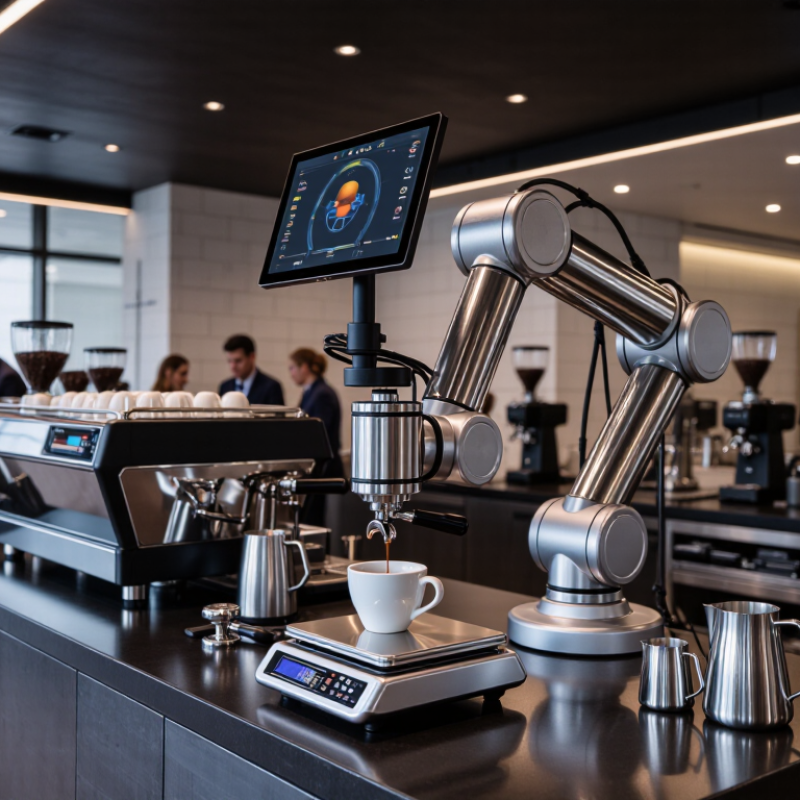
A robot arm coffee machine is an automated brewing station that uses a mechanical arm to handle coffee preparation. It can lift cups, position them under a grinder, operate brewing controls, and deliver the finished drink. Sensors guide each movement. Software controls the recipe, timing, and cup location.
In practical demonstrations, the arm usually works beside a grinder, brewer, milk system, and cleaning unit. A camera or proximity sensor can detect misplaced cups. The machine may repeat a programmed sequence with impressive consistency. The result feels futuristic. Yet small errors still happen. A cup may shift slightly, or milk foam may vary with temperature. Human supervision remains valuable during busy service.
Evaluating a supplier requires more than watching a smooth demonstration. Technical documents should explain the arm’s payload, movement range, cleaning process, and maintenance intervals. Food-contact parts need suitable materials and clear sanitation instructions. Safety features should include guarded movement areas, emergency stopping, and controlled access. Reliable suppliers also provide operator training, spare-part planning, and documented testing.
Installation conditions matter too. Power supply, water quality, drainage, ventilation, and counter space can affect performance. An experienced café operator should test several drink cycles before purchase. Taste consistency matters more than theatrical movement. I would also ask for service response times and real maintenance records. A polished display does not prove long-term reliability.
How Robot Arm Coffee Machines Work
2026 Best Robot Arm Coffee Machine Suppliers?
How Robot Arm Coffee Machines Work
A robot arm coffee machine combines a programmable arm, coffee brewer, sensors, and a control system. The process starts when a customer selects a drink on the interface. The controller converts that order into timed movements and brewing instructions.
The arm may collect a cup, position it under a grinder, and place it beneath the brewer. A separate tool can add milk, syrup, ice, or a lid. Sensors check the cup’s position and help prevent misalignment. The machine also monitors brewing time, liquid volume, and temperature. Small changes matter.
In practical operation, calibration is essential. A slightly shifted tool can produce uneven milk foam or spill coffee. Cleaning routines must cover the nozzle, milk path, drip tray, and contact surfaces. Automated does not mean maintenance-free. It still needs trained staff and daily inspection.
Coffee suppliers should examine movement accuracy, cleaning access, software controls, and service support. A demonstration can reveal more than a brochure. Watch the arm repeat the same order several times. Does the cup remain stable? Does the drink quality change? The answer may expose weaknesses. Even advanced systems can struggle with unusual cup sizes, crowded counters, or sensor glare. Human oversight remains useful, especially during busy service periods.
Key Features of Leading 2026 Suppliers
2026 Best Robot Arm Coffee Machine Suppliers?
Leading 2026 suppliers should offer more than a robotic arm and attractive touchscreen. The strongest systems combine repeatable dosing, adjustable grinding, temperature control, and rapid cleaning access. According to the International Federation of Robotics’ World Robotics 2024 report, professional service robot sales exceeded 200,000 units in 2023. This growth increases pressure on suppliers to prove reliability, not just novelty.
Food-safe materials matter. So do sealed milk lines, automatic rinsing, emergency stops, and clear maintenance records. Suppliers should provide local technicians, spare-part availability, software updates, and operator training. The U.S. Food Code 2022 also emphasizes hygienic equipment design and contamination control. A machine that makes excellent espresso but traps residue behind its joints is not truly advanced. That detail is easy to miss.
Energy monitoring is another useful feature. The International Energy Agency reports that efficient appliances can reduce operating costs across commercial facilities, although savings depend on usage and maintenance. Leading suppliers should publish power consumption, cycle times, drink consistency data, and uptime results from real cafés. Ask for evidence. Marketing claims alone are weak. In my view, fully autonomous cleaning remains an overpromised area; staff still need to inspect nozzles, drains, and contact surfaces. Human oversight is still necessary.
| Evaluation Dimension | Recommended 2026 Supplier Capability | Typical Technical Benchmark | Why It Matters for Robot Arm Coffee Machines | Evidence Buyers Should Request |
|---|---|---|---|---|
| Robot Arm Configuration | Industrial or collaborative robotic arm integration with a purpose-designed beverage workspace | 4–6 axes for common drink preparation and cup-handling tasks | Multiple axes allow the arm to reach the grinder, brewer, cup station, ice station, and cleaning area with fewer mechanical constraints. | Robot model specification, reach diagram, payload rating, safety assessment, and an operating video showing the complete workflow. |
| Repeatability and Motion Control | Programmed motion profiles with calibrated pick-and-place points and recipe-based sequencing | Repeatability commonly specified in millimetres; the supplier should state its tested value for the complete system | Consistent positioning helps prevent cup collisions, inaccurate dosing, spills, and variation between beverages. | Factory acceptance test, repeatability report, calibration procedure, and sample results from repeated drink cycles. |
| Beverage Throughput | Capacity matched to the intended location, menu size, and peak service period | Throughput should be quoted as completed drinks per hour under a defined menu and cleaning schedule | A headline cycle time can be misleading if it excludes grinding, milk steaming, ingredient replenishment, waste handling, or cleaning. | Timed demonstration using the buyer’s target menu, queue assumptions, drink sizes, and peak-hour operating conditions. |
| Coffee and Ingredient Dosing | Integrated control of coffee dose, grind setting, water volume, milk, syrups, and other recipe inputs | Recipe parameters should be digitally configurable and protected by user permissions | Digital recipes improve consistency and make menu updates easier without manually adjusting every machine component. | Recipe-management interface, dosing accuracy test, ingredient compatibility list, and change-control documentation. |
| Food and Beverage Safety | Hygienic design with food-contact materials, accessible cleaning points, and controlled cross-contamination risks | Food-contact components should be documented for suitability and designed for routine sanitation | Coffee machines combine heat, moisture, milk, and organic residue, making cleaning access and sanitation procedures essential. | Material declarations, cleaning and sanitation schedule, hazard analysis, food-contact compliance documents, and maintenance access drawings. |
| Milk-System Management | Refrigerated or otherwise controlled milk delivery with automated rinsing and clear end-of-day cleaning procedures | The supplier should specify milk temperature limits, storage capacity, purge cycles, and cleaning frequency | Milk systems require stricter temperature and hygiene control than black-coffee systems and can become a major service risk. | Milk-line diagram, temperature records, cleaning validation, alarm logic, and instructions for replacing tubing and seals. |
| Safety and Human Interaction | Risk assessment covering robot motion, hot liquids, steam, sharp components, pinch points, and customer access | Emergency stop, guarded zones or validated collaborative operation, fault detection, and restart controls | Public-facing installations require protection for customers, staff, technicians, and nearby equipment. | Risk assessment, safety circuit description, emergency-stop test, operating-zone layout, and applicable conformity documentation. |
| Software and Connectivity | Remote monitoring, recipe administration, event logging, and integration options for payment or ordering systems | Role-based access, encrypted communication, diagnostic logs, and documented API or integration interfaces | Connected software reduces downtime and allows operators to monitor errors, consumables, usage, and service needs remotely. | Network architecture, cybersecurity policy, uptime dashboard, API documentation, data-retention policy, and software update process. |
| Reliability and Serviceability | Modular components, preventive-maintenance plan, replaceable wear parts, and trained local service coverage | Supplier should provide a documented maintenance interval, spare-parts list, response target, and escalation process | Downtime can remove the commercial benefit of automation, especially in unattended or high-traffic locations. | Service-level agreement, spare-parts availability statement, technician training plan, preventive-maintenance checklist, and reference-site data without confidential brand details. |
| Cleaning and Waste Handling | Automated rinsing where practical, accessible waste containers, spill detection, and clear operator prompts | Cleaning time, water use, waste capacity, and required manual interventions should be stated per operating day | Cleaning workload directly affects labour cost, hygiene performance, and machine availability. | Daily operating procedure, water-consumption figures, waste-capacity calculation, cleaning-time demonstration, and consumables list. |
| Customization and Deployment | Configurable workspace, cup sizes, menu logic, payment interface, enclosure, and site utilities | Supplier should provide utility requirements for power, water, drainage, ventilation, network access, and floor loading | Many installations fail during deployment because the site cannot support the required utilities, clearances, or customer flow. | Site-readiness checklist, dimensional drawings, utility schedule, installation method statement, and commissioning plan. |
| Training and Documentation | Operator, technician, cleaning, troubleshooting, and emergency procedures supplied in clear digital and printed formats | Training should cover routine operation, ingredient replenishment, cleaning, fault recovery, and safe shutdown | Well-structured documentation reduces operator error and helps maintain beverage quality after installation. | Sample manuals, training agenda, competency checklist, multilingual support scope, and post-installation handover process. |
| Total Cost of Ownership | Transparent pricing covering equipment, installation, software, consumables, service, spare parts, and end-of-life handling | Compare five-year total cost rather than purchase price alone | Consumables, cleaning products, software fees, maintenance labour, and downtime can materially change the economic result. | Five-year cost model, warranty terms, service pricing, consumables forecast, energy and water assumptions, and replacement-part schedule. |
How to Compare Robot Arm Coffee Machine Suppliers
2026 Best Robot Arm Coffee Machine Suppliers?
How to Compare Robot Arm Coffee Machine Suppliers
Choosing a robot arm coffee machine supplier requires more than watching a smooth pouring demonstration. In real cafés, machines face heat, moisture, rush periods, and frequent cleaning. Compare arm reach, positioning accuracy, brewing speed, noise, and daily operating limits. Ask for test records, maintenance schedules, food-contact material details, and clear warranty terms. A reliable supplier should explain limitations without hiding behind impressive videos.
I have found that installation support often matters as much as machine performance. Request a live demonstration using your preferred cup sizes, coffee recipes, and workspace layout. Check how quickly staff can learn basic operation. Review spare-part availability, software update procedures, and remote support response times. My early evaluations focused too much on automation speed. That was a mistake. Cleaning access and recovery after a failed movement mattered more during busy service.
Tips: Compare at least three suppliers with the same test checklist. Measure drink consistency after repeated cycles. Ask who handles installation and training. Request customer references from similar cafés. Read the service agreement carefully. A low purchase price may hide expensive downtime. Do not accept vague answers about sanitation, data security, or replacement parts. Small details matter.
Safety, Maintenance, and Buying Considerations
2026 Best Robot Arm Coffee Machine Suppliers: Safety, Maintenance, and Buying Considerations
A robot arm coffee machine should be judged beyond speed and appearance. During a practical trial, watch the arm move near hands, cups, and hot liquid. The machine needs physical guarding, reliable sensors, and a clearly reachable emergency stop. Ask suppliers for risk assessments, electrical certifications, and food-contact material documentation. Requirements vary by location, so local compliance checks remain essential. A polished demonstration proves little.
Maintenance often determines the real operating cost. Select a design with removable drip trays, accessible brewing parts, and washable surfaces. Milk lines need frequent cleaning, especially after busy service periods. Check whether staff can replace seals, filters, and nozzles without specialized tools. Ask about spare-part availability, technician response times, and remote fault support. Keep a simple daily log. It should record cleaning, errors, and unusual sounds.
Buying decisions should include a live test using your own cups, recipes, counter height, and peak-hour queue. Measure drink consistency, recovery time, noise, and cleaning duration. A cheaper machine may become expensive when downtime or imported parts appear. Warranty terms deserve careful reading, particularly for the robot joint and heating system. I would also request a failure simulation, such as an interrupted cycle or misplaced cup. Suppliers may resist this. That resistance is informative, though not conclusive. Human oversight is still necessary; automation can reduce repetitive work, but it cannot replace sensible supervision.
Related Posts
-
How to Choose a Robotic Barista Coffee Machine?
-

How to Choose a Robotic Coffee Barista for Your Business
-
7 Best Coffee Bot Machines for Global Buyers
-
Revolutionizing Coffee Production: The Ultimate Guide to Coffee Robot Machines for Global Buyers
-
5 Benefits of Owning a Cafe Latte Robot for Your Coffee Business
-
Transforming Beverage Automation: The Impact of Cafe Latte Robot at 2025 China Import and Export Fair