What Are the 2026 Top Latte Art Robot Types?
Coffee service is becoming more visual, faster, and increasingly automated. The International Coffee Organization estimated global coffee consumption at 177.9 million 60-kilogram bags in 2023/24. This expanding demand increases pressure on cafés to deliver consistent drinks during busy periods. A Latte Art Robot can respond by printing flowers, rosettas, logos, or simple animal shapes on milk foam. The result is visible within seconds.
This article examines the leading Latte Art Robot types expected to matter in 2026. The main categories include two-dimensional foam printers, robotic-arm systems, three-dimensional foam sculpting machines, and modular countertop units. Each type serves a different operating environment. A small café may value compact design and simple cleaning. A hotel or chain may prioritize speed, software control, and repeatable branding. The categories are not perfectly clean. Some machines combine printing, dispensing, and robotic movement in one platform.
Professional reports provide useful context, but they do not guarantee commercial success. The National Coffee Association’s 2024 National Coffee Data Trends report found that 67% of American adults drank coffee in the past day. Specialty coffee also remained a strong consumer segment. That demand supports investment in presentation technology. However, foam temperature, milk texture, cup shape, and operator training still affect the final image. Technology alone cannot repair poor extraction or unstable microfoam. It is a tempting assumption.
This guide compares each robot type through practical criteria, including image quality, throughput, maintenance, hygiene design, integration, and total operating cost. It also considers current limitations. A beautiful first sample may fade during a crowded morning shift. Reliable equipment must perform beyond the showroom.
What Defines a Latte Art Robot in 2026?
What Are the 2026 Top Latte Art Robot Types?
What Defines a Latte Art Robot in 2026?
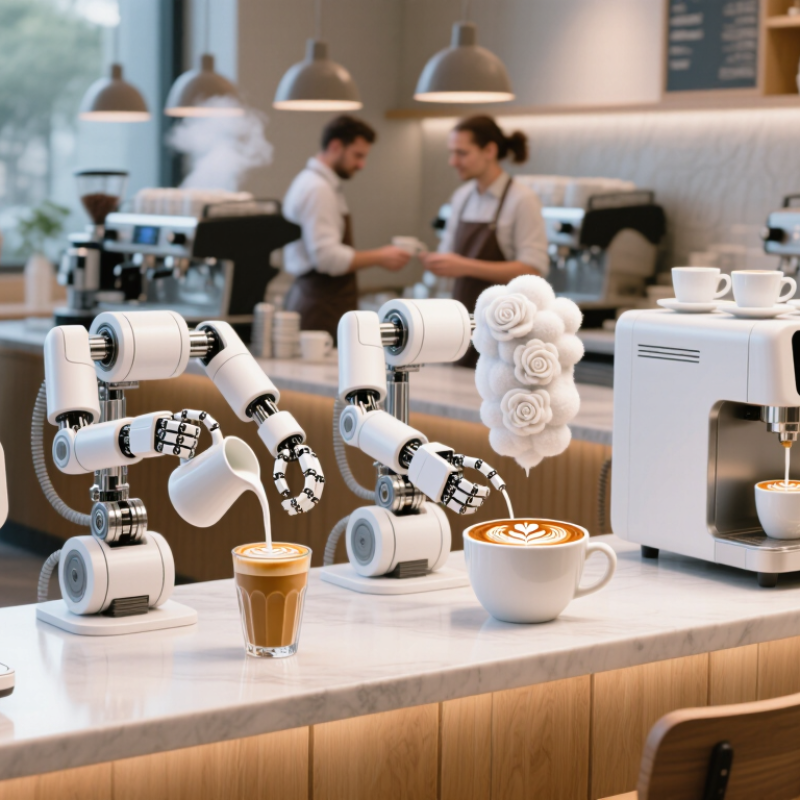
A latte art robot is more than an automated milk dispenser. It combines motion control, temperature awareness, and pattern guidance to shape foam on coffee. In 2026, reliable systems usually monitor cup position, milk flow, and surface movement. This helps reduce uneven hearts, rosettas, and tulip designs during busy service.
Several robot types are becoming practical. Gantry systems move a nozzle across fixed rails, creating steady lines with repeatable speed. Robotic-arm models offer broader movement and can work around different cup positions. Compact tabletop units suit small cafés, training rooms, and self-service counters. Vision-assisted machines add cameras to check foam texture and cup alignment before drawing.
The strongest systems still depend on preparation. Milk must have suitable microfoam, and the cup needs a stable surface. A robot cannot fully correct overheated milk or poorly extracted coffee. Not yet. From practical testing, consistency improves when operators clean nozzles often and calibrate movement each day. However, automated patterns can look too identical, which may reduce the handmade character many customers value. Manufacturers should also provide clear maintenance records, safety controls, and measurable performance data. A polished demonstration is useful, but repeatable results over many cups matter more.
What Are the 2026 Top Latte Art Robot Types? - What Defines a Latte Art Robot in 2026?
| Robot Type | Core Motion System | Typical Pouring Method | Best-Suited Latte Art | Strengths | Key Limitations | Typical Operating Environment | Automation Level | Precision Potential |
|---|---|---|---|---|---|---|---|---|
| Articulated Arm Robot | Multi-joint arm with coordinated movement across several axes | Moves a milk pitcher or dispensing tool through programmed paths | Rosettas, hearts, tulips, swans, and customized multi-stage patterns | Flexible movement Complex designs High reach | Higher installation and programming complexity; requires careful workspace safety controls | High-volume cafés, demonstrations, training centers, and automated beverage stations | High | High |
| Collaborative Robot Arm | Force-limited robotic arm designed to operate near trained staff | Controls pitcher angle, height, travel speed, and pour timing | Repeatable hearts, tulips, rosettas, and personalized patterns | Flexible installation Human collaboration Programmable | Still needs calibrated milk texture, defined operating procedures, and suitable safety settings | Specialty cafés, hospitality venues, culinary schools, and interactive retail spaces | High | High |
| Cartesian or Gantry Robot | Linear movement along fixed X, Y, and Z axes | Moves a pitcher, nozzle, or cup platform along repeatable straight-line paths | Hearts, simple rosettas, geometric patterns, and repeated designs | Stable motion Repeatability Easy calibration | Less natural for highly curved movements; requires a defined footprint and fixed cup position | Self-service kiosks, production counters, laboratories, and compact automated lines | High | High |
| SCARA-Style Robot | Selective-compliance arm using rapid horizontal positioning with vertical control | Positions a dispensing nozzle or pitcher over a fixed cup | Simple hearts, logos converted into line patterns, and consistent surface designs | Fast positioning Compact footprint Repeatable cycles | More restricted wrist orientation and less suitable for natural hand-pouring gestures | Fast-service counters, kiosk systems, and controlled beverage production areas | High | Medium–High |
| XY Plotter Latte Art Robot | Two-axis positioning system, usually with a vertical actuator | Moves a narrow milk or edible-coloring nozzle over the drink surface | Line drawings, icons, names, text, and geometric illustrations | Detailed graphics Simple mechanics Digital designs | Usually creates surface drawings rather than traditional free-pour texture; design quality depends on contrast and nozzle control | Events, promotional counters, cafés offering customized beverages, and educational demonstrations | Medium–High | High for line art |
| Cup-Motion Robot | Moves and tilts the cup while the milk source remains fixed or semi-fixed | Uses controlled cup rotation, translation, and tilt during milk delivery | Hearts, tulips, layered patterns, and repeatable traditional motifs | Consistent cup handling Compact dispensing head Repeatable geometry | Requires reliable cup positioning and careful coordination between milk flow and cup movement | Countertop systems, training environments, and automated drink finishing stations | Medium–High | Medium–High |
| Nozzle-Based Dispensing Robot | Fixed or motorized nozzle with electronically controlled liquid flow | Dispenses aerated milk, foam, or plant-based alternatives through a calibrated nozzle | Simple hearts, dots, layered pours, and programmed surface patterns | Consistent dosage Fast operation Low manual handling | May produce less organic texture than a skilled free pour; nozzle hygiene is critical | High-throughput kiosks, vending-style systems, and standardized beverage operations | High | Medium |
| Vision-Guided Latte Art Robot | Robotic mechanism combined with cameras or optical sensors | Adjusts pour position, timing, or movement after analyzing the cup and foam surface | Adaptive hearts, rosettas, customized graphics, and correction-based designs | Adaptive control Error detection Personalization | Higher software and calibration requirements; performance depends on lighting, contrast, and image quality | Advanced cafés, research facilities, premium hospitality, and smart beverage kiosks | Very High | High |
| Hybrid Human–Robot System | Robot performs repeatable pouring or positioning while staff control preparation and finishing | Automated milk delivery combined with manual texture adjustment or final presentation | Traditional free-pour designs with improved consistency and staff-guided customization | Human flexibility Process consistency Easier adoption | Not fully autonomous; final results still depend on staff skill and beverage preparation quality | Specialty coffee shops, training programs, hotels, and high-touch service environments | Medium–High | High with skilled operators |
In 2026, a latte art robot is generally defined by coordinated control of milk flow, pitcher or nozzle movement, cup positioning, timing, and—where available—sensor-based adjustment. Final performance still depends on espresso crema, milk temperature, foam structure, nozzle hygiene, and calibration.
Related Posts
-
Challenges in Achieving Precision Coffee Brewing Standards with Barista Robots
-
Top 10 Robot Coffee Maker Manufacturers from China at the 137th Canton Fair
-
7 Surprising Reasons Why Barista Bot Smart Coffee Machine is the Best Choice
-
15 Amazing Best Coffee Bot Machines for Every Coffee Lover
-
Top 10 Coffee Today Robot Innovations You Should Know?
-
5 Benefits of Owning a Cafe Latte Robot for Your Coffee Business